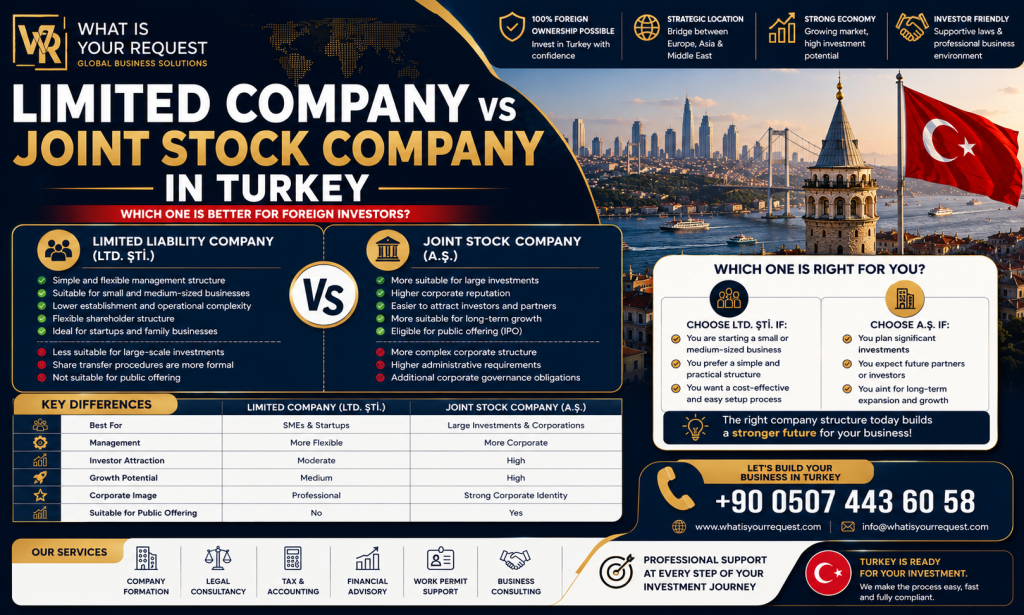
Limited Company vs Joint Stock Company in Turkey: Which One Is Better for Foreign Investors? (2026 Complete Guide)
- Haziran 15, 2026
- Yayınlayan: admin
- Kategori: Business plans
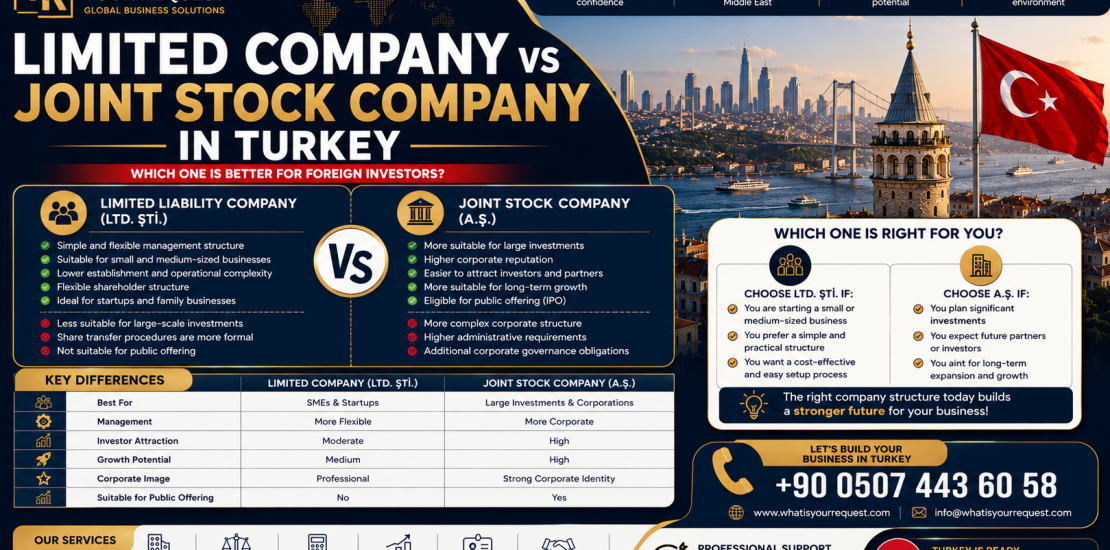
Choosing the Right Company Type in Turkey
Foreign investors planning to start a business in Turkey often ask:
“Should I establish a Limited Liability Company (Ltd. Şti.) or a Joint Stock Company (A.Ş.)?”
Both company types allow foreign investors to own 100% of the shares and operate under Turkish commercial regulations. However, they differ in terms of structure, capital requirements, management flexibility, investment opportunities, and future growth plans.
Choosing the right company type is one of the most important decisions when entering the Turkish market.
What Is a Limited Liability Company (Ltd. Şti.)?
A Limited Liability Company is one of the most preferred business structures in Turkey, especially for small and medium-sized enterprises.
Advantages of a Limited Company
✔ Simple and practical management structure
✔ Suitable for small and medium-sized businesses
✔ Lower establishment and operational complexity
✔ Flexible shareholder structure
✔ Ideal for family businesses and startups
Disadvantages of a Limited Company
❌ Less suitable for large-scale investments
❌ Share transfer procedures may be relatively more formal
❌ Not generally preferred for public offerings
What Is a Joint Stock Company (A.Ş.)?
A Joint Stock Company is generally preferred by larger investors, corporations, and businesses with long-term expansion goals.
Advantages of a Joint Stock Company
✔ More suitable for large investments
✔ Higher corporate reputation
✔ Easier investment and partnership opportunities
✔ More suitable for attracting investors
✔ Eligible for public offering under relevant regulations
Disadvantages of a Joint Stock Company
❌ More complex corporate structure
❌ Higher administrative requirements
❌ Additional corporate governance obligations
Limited Company vs Joint Stock Company: Key Differences
| Feature | Limited Company (Ltd.) | Joint Stock Company (A.Ş.) |
|---|---|---|
| Best For | SMEs & Startups | Large Investments |
| Management | More Flexible | More Corporate |
| Investor Attraction | Moderate | High |
| Growth Potential | Medium | High |
| Corporate Image | Professional | Strong Corporate Identity |
| Suitable for Public Offering | No | Yes |
Which Company Type Is Better for Foreign Investors?
The answer depends on your investment goals.
Choose a Limited Company if:
✔ You are starting a small or medium-sized business
✔ You prefer a simple management structure
✔ You want a practical and cost-effective setup
Choose a Joint Stock Company if:
✔ You plan significant investments
✔ You expect future partners or investors
✔ You aim for long-term expansion
✔ You require a stronger corporate structure
Tax Differences Between Ltd. and A.Ş. Companies in Turkey
Both Limited Companies and Joint Stock Companies are generally subject to similar corporate taxation rules in Turkey.
However, there may be differences in areas such as:
- Dividend distribution procedures
- Corporate governance obligations
- Share transfer processes
- Management structures
Professional legal and tax advice is recommended before choosing a company type.
Professional Company Formation Consultancy in Turkey
At What Is Your Request, we guide foreign investors in selecting the most suitable company structure based on their business model and investment objectives.
Our services include:
✔ Company Type Analysis
✔ Company Formation Procedures
✔ Tax & Accounting Consultancy
✔ Legal Consultancy
✔ Investment Planning
✔ Corporate Compliance Support
Start Your Turkish Business with the Right Structure
Choosing between a Limited Company and a Joint Stock Company is a strategic decision that affects your company’s future.
Our experienced legal and financial professionals help you establish the right business structure in Turkey quickly and efficiently.
Contact What Is Your Request today and choose the best company type for your investment.